Last Friday was the first day of actual getting down to it at the Alpine Fund. Basically, many areas for improvement were revealed by the expected arrival of a volunteer for which the Alpine Fund seemed quite unprepared. This was similar to my arrival. But I will be here for six months. This volunteer will be here for two or three weeks and apparently he thought we would be able to occupy most of his time here. Somewhere there was a miscommunication that might be better characterized as a non-communication. So that is one thing to do better: communicate accurately with potential volunteers before they arrive so that all parties are prepared. As of now The Alpine Fund is a part time NGO run by a dedicated and responsible law student. She does a great job with limit time and resources.
After a stop-and-go meeting with the new volunteer, it was the perfect time for Arianna and I to hash out exactly what the Alpine Fund does and how it does these things. I then asked her some questions about the organization and, when appropriate, offered some ideas from the PSO playbook. There is also a lack of delegation or division of administration for the related-but-distinct activities of the Fund. Thus we discussed officially delegating and separating the weekly classes, the trips, the special events and the administration. Naturally there will be overlap and people need to be flexible, but having a good idea or who is responsible for what will help give me direction and keep me from feeling overwhelmed. Otherwise there would be a danger of being overwhelmed by possibilities, none of which are urgent and then stalling in confused discouragement.
As I wrote in an email to a friend, I have arrogantly begun not so much restructuring as just structuring the Alpine Fund. Inspired by God, I first considered trying to structure the administration in my own likeness. I fear, however, that the human form makes for a poor administrative body. I am making things like “data bases,” a “volunteer placement form” and a “master calendar.” I have to say that my crowning vainglorious achievement, however will probably be trying to put a dollar figure on the joy of orphans when they go to the mountains. Yessir, nothing sucks the humanity out of an NGO (to make room for new grants) like a little old-school econ101 utility maximization formulae.
There are lots of little things to do also, basically the goal for me will be institutionalization such that the Alpine Fund can survive being jostled between competent hands in a regularly unsynchronized fashion.
On the home front, I have discovered what I suspected after our big feast; no one in the family drinks (certainly none of the women and certainly not at home). I can see why people would shun the drink. When unemployment, corruption and poverty are high, drinking is often a sad, forlorn and helpless affair. The resignation to despair that only reinforces this downward social spiral is an ugly thing.
Then there is the scene which I am more familiar with, the Young American/Anglo Party Drinking. Far from despair, this manifests as revelrous delight and vainglorious pomp. It’s usually fun and it smells of decadence.
Of course often the two intersect. There is the fun for moment which veils underlying sadness, depression, soul adrift. Sad all day, happy when they drink.
And there those who wash away the phony smiles of the work week to wallow in despondency. Happy all day, sad when they drink.
In those terms, there is not much good to say about drink. Indeed it is fair to say that alcoholism is dumb and that it sucks. This sucky dumbness seems to me most acute in rural areas where other flashy distractions of civilization do not exist. Alcohol is the only route for the weary escapees.
So, why did it bother me somewhere far back in my mind that the family complete rejects drinking? Now, my dominant rational self hold no grudges and think nothing less of my wonderfully hospitably host family for their adherence to values that have clearly led to general happiness and success. But I will not lie to myself, nor to anyone else, rejection of drinking entirely out of hand strikes me as a bit drastic and a small voice inside protests. Maybe a little decadence and despair is healthy. For me, it has given life a flavor that puritan living would lack.
It’s that precocious Golden Mean. A little excess, in moderation, allows us to see our faults and potentials all the more clearly. It is never good to obsess over either, but keeping ‘em in mind can’t hurt.
Monday, October 30, 2006


Friday, October 27, 2006
Bazaar English
October 26th – 25 kulatov
Waking following first light, the mountains to the south of the city were large and snow covered. There was a thunderstorm on the 25th. My main achievement for the day was setting up Russian and Kyrgyz classes starting next week. For $360 dollars I will get a month of 6 hr/day instruction five days a week. That is 120 hours of class. I will do 3 hours of Russian and 3 of Kyrgyz a day. I will be exhausted by the time I get to the Fund, but with prices this low I’d be crazy not to! Right?!?! Right?!
For those of you curious where exactly my Russian stands, I was rated as Pre-Intermediate. A more un-outstanding rating would be quite impossible.
I made it back to the Fund to teach my first English class. Only one pupil showed. Her name is Salavat, a girl of 16. She has parents but doesn’t know who they are or where they are. She lives with her teacher at her prep college. Her older sister is rumored to be working in a café in Bishkek her face is on an Alpine Fund mini-calender. She loved to climb to relax. Salavat’s younger sister is in an orphanage hours outside of town. Salavat wants to speak English perfectly so that she can teach English and eventually come the USA to teach Russian. Though she was born to a Kyrgyz mother, she does not speak the language. As a result she is not sure whether she is Russian or Kyrgyz, or neither or both. Another befuddled victim of ethno-nationalism. Her grandmother is known and a “good woman.” Salavat visits her about an hour outside of town on free Sundays. Apparently her kids have abandoned her to a village with spoilt water even though they are “rich.”
The English teaching aspect of the Alpine Fund is quite small or to put it positively, precisely targeted. Larger outreach is beyond Fund’s ability/will-power for now. The orphanage closest to the Fund is run by a parasitic director nicknamed Satan by staffers. Regular English lessons should be easy and fruitful at this orphanage but Satan makes it not worth while. The Alpine Fund does not give material goods that can be misappropriated and sold for personal profit. Therefore, Satan wants nothing to do with us and would just assume not have meddlesome foreigners whistle-blowing or muttering about propriety in the corner. Another orphanage is well run but located 1½ hours outside of town (by crowded uncomfortable standing-room only Marshrootka). Thus to do an English lesson a volunteer would have to commit at least 6 hours. As projects such as this come and go on a volunteer by volunteer basis they are a daunting undertaking. The prospect of all ground being given up once a volunteer goes home and no one is there to take his/her place tips the scales in favor of discouragement. This is an example of something that I think we should be able to do with better consistency and organization. We may not be ready. It may be better to do a better job at what we already do than try and expand.
The Fund’s English classes focus on former orphans that became involved on the weekend climbs or weekly climbing-wall sessions that are now on the cusp between University and a life of low-wage labor in the bazaar (should they not get mixed up in a bad crowd). We teach 3 or 4 15-17 year old kids English once a week. These kids are too old to be in the orphanages which are geared to school kids only through the equivalent of 9th grade. Under the Soviet system they would then attend a technical college for 2-3 year and graduate as blue-collar professions. That system is now defunct but the orphanages are not reformed. The result is a bona fide dead end. But, if they score well enough on a TOEFL test or can raise the money to go to a year of university prep, they will almost certainly gain admittance to a local university where they will qualify for a full-ride on account of their destitute status.
Anna and Sean are trying to get about $1,000 together for a scholarship for Ulan, a very motivated and smart bazaar kid. His parents are blind so he was put into the orphanage. Now that he can’t stay there anymore he loads trucks at the bazaar all day to support his family. He studies English at night with the help of the AF classes. He even brings books home to soak up. He didn’t show up my night of English, but he is the star of the show right now. For kids like Salavat and Ulan, the Fund makes worlds of difference.
That is wonderful but it just feels like so few kids for an entire NGO. Others take part in the outdoors activities, as many as 60 kids a month. The impact of that is more of a break from an orphanage. A couple days of joy… a worthy cause in its own right but fleeting.
These impressions are just what I have picked up the last couple of days. I have no doubt made mistakes and am unaware of important information. I will continue to flush out the Fund on the blog as a means of helping me see what I should be doing. I have done almost no work for the Fund despite spending the last two days there. I have been meeting the people, learning what is up and getting my own life together. Speaking of getting it together, I was reunited with my bag. YAY! I had another good conversation with my host sister and mother about linguistics, fittingly this conversation took place in three languages, only my host sister took part in all of it. Did you know that modern Turkish and Japanese are both descendents of Hun? It’s True! My family here has the poster to prove it!
Waking following first light, the mountains to the south of the city were large and snow covered. There was a thunderstorm on the 25th. My main achievement for the day was setting up Russian and Kyrgyz classes starting next week. For $360 dollars I will get a month of 6 hr/day instruction five days a week. That is 120 hours of class. I will do 3 hours of Russian and 3 of Kyrgyz a day. I will be exhausted by the time I get to the Fund, but with prices this low I’d be crazy not to! Right?!?! Right?!
For those of you curious where exactly my Russian stands, I was rated as Pre-Intermediate. A more un-outstanding rating would be quite impossible.
I made it back to the Fund to teach my first English class. Only one pupil showed. Her name is Salavat, a girl of 16. She has parents but doesn’t know who they are or where they are. She lives with her teacher at her prep college. Her older sister is rumored to be working in a café in Bishkek her face is on an Alpine Fund mini-calender. She loved to climb to relax. Salavat’s younger sister is in an orphanage hours outside of town. Salavat wants to speak English perfectly so that she can teach English and eventually come the USA to teach Russian. Though she was born to a Kyrgyz mother, she does not speak the language. As a result she is not sure whether she is Russian or Kyrgyz, or neither or both. Another befuddled victim of ethno-nationalism. Her grandmother is known and a “good woman.” Salavat visits her about an hour outside of town on free Sundays. Apparently her kids have abandoned her to a village with spoilt water even though they are “rich.”
The English teaching aspect of the Alpine Fund is quite small or to put it positively, precisely targeted. Larger outreach is beyond Fund’s ability/will-power for now. The orphanage closest to the Fund is run by a parasitic director nicknamed Satan by staffers. Regular English lessons should be easy and fruitful at this orphanage but Satan makes it not worth while. The Alpine Fund does not give material goods that can be misappropriated and sold for personal profit. Therefore, Satan wants nothing to do with us and would just assume not have meddlesome foreigners whistle-blowing or muttering about propriety in the corner. Another orphanage is well run but located 1½ hours outside of town (by crowded uncomfortable standing-room only Marshrootka). Thus to do an English lesson a volunteer would have to commit at least 6 hours. As projects such as this come and go on a volunteer by volunteer basis they are a daunting undertaking. The prospect of all ground being given up once a volunteer goes home and no one is there to take his/her place tips the scales in favor of discouragement. This is an example of something that I think we should be able to do with better consistency and organization. We may not be ready. It may be better to do a better job at what we already do than try and expand.
The Fund’s English classes focus on former orphans that became involved on the weekend climbs or weekly climbing-wall sessions that are now on the cusp between University and a life of low-wage labor in the bazaar (should they not get mixed up in a bad crowd). We teach 3 or 4 15-17 year old kids English once a week. These kids are too old to be in the orphanages which are geared to school kids only through the equivalent of 9th grade. Under the Soviet system they would then attend a technical college for 2-3 year and graduate as blue-collar professions. That system is now defunct but the orphanages are not reformed. The result is a bona fide dead end. But, if they score well enough on a TOEFL test or can raise the money to go to a year of university prep, they will almost certainly gain admittance to a local university where they will qualify for a full-ride on account of their destitute status.
Anna and Sean are trying to get about $1,000 together for a scholarship for Ulan, a very motivated and smart bazaar kid. His parents are blind so he was put into the orphanage. Now that he can’t stay there anymore he loads trucks at the bazaar all day to support his family. He studies English at night with the help of the AF classes. He even brings books home to soak up. He didn’t show up my night of English, but he is the star of the show right now. For kids like Salavat and Ulan, the Fund makes worlds of difference.
That is wonderful but it just feels like so few kids for an entire NGO. Others take part in the outdoors activities, as many as 60 kids a month. The impact of that is more of a break from an orphanage. A couple days of joy… a worthy cause in its own right but fleeting.
These impressions are just what I have picked up the last couple of days. I have no doubt made mistakes and am unaware of important information. I will continue to flush out the Fund on the blog as a means of helping me see what I should be doing. I have done almost no work for the Fund despite spending the last two days there. I have been meeting the people, learning what is up and getting my own life together. Speaking of getting it together, I was reunited with my bag. YAY! I had another good conversation with my host sister and mother about linguistics, fittingly this conversation took place in three languages, only my host sister took part in all of it. Did you know that modern Turkish and Japanese are both descendents of Hun? It’s True! My family here has the poster to prove it!
Thursday, October 26, 2006
From Bulgaria to Bishkek
I put this post in chronological order. The stuff from Sofia is first. WeSorry about the lack of photos. I will get those up... eventually.
Silly Stories of Bulgaria
-The Guru-
An elderly man staying several nights at the hostel in Sofia landed the unfortunate bed directly next to the door to the main living room. 1.5 inches of pine separated his resting head and the voices of our hostel’s night scene. The receptionist did her best to beat them but eventually gave in to Jenga’s powerful allure.
He never complained, however. He lay stiff as a board, impossible to tell if he managed to out-sleep the din. He was thin, almost frail, with grey hair and a full if unkept white beard. He looked old, not senile. Perhaps 70. His motions were stiff, abrupt and deliberate especially when he walked and got into and out of his bunk. He never appeared either in pain or at ease. His awkward movements were on account of a chronic deterioration of his nervous control that originated with whip-lash from a joy ride gone wrong at 16.
He was quiet, his social mannerisms mirrored his physical movements. Slow, simple, awkwardly abrupt. None doubted that he had the making of a first-rate guru.
True to form, after a couple days of lingering silently with hunched shoulder on the margins of our little hostel universe, he joined one of the periodic conversations about where someone was going or where they had come from. These most often occur just before dinner as new guests, rested and settled explore the social space of their new home hoping for kindred sprits or at least some good tips about where to go and what to do.
He piped up and all of us, younger and eager to hear from the mysterious man of many years in our midst, piped down to listen, “you know I first went to that area [Iran] in the 1960s. Back then the thing to do was the 3Ks… Kabul, Kathmandu and…” We brainstormed for the final K for a few moments. Despite the formidable knowledge of geography between us, the final K escaped us. I suggested Kashgar even though that area would have likely been a no-go during Mao’s reign. Seeing the wisdom in my incorrect response, the others gladly turned a blind eye to its obvious deficiencies and we turned back to our mentor.
“Yeah, well of course then you could go to all those places you can’t really go today and then back then there was no chance of traveling where you guys are headed [destinations in former Communist Eastern Europe].”
With that he retreated to silence… having been brought to a conversational impasse, we interrogated the elder gentleman for his story.
Canadian, worked for the [Royal Mounted?] Canadian Weather Service before retirement from Yukon to remote posts in BC, traveling his hobby. He takes it in legs of a month to two months, has been everywhere at least once. Living alone he writes an annual 12 page letter to former companions every January.
The next day he approached me suddenly and stood by my bed until I was sure he really wanted to talk to me and stopped reading.
“You know the other day I was thinking about our conversation from the other day.”
“yesterday?”
“Another big difference between traveling then and now is the water. You couldn’tt drink the water most anywhere back then and today it’s good in most everywhere.”
“Yeah, huh.”
“Yup, we always were drinking tea back then. All the time all day long hot tea.”
“That’s a lot of tea.”
“Oh yeah. And of course back then we didn’t talk about human trafficking and other academic stuff. Mostly travelers were burned out drifters that hated talking about booze, sex and weed but couldn’t speak to anything else.”
“Geez.”
“Well, that or ignorant hippies hoping for a spiritual revelation during a two month road trip.”
The guru scoffed at cathedrals. “No thanks. Not another European cathedral.” Long may he runneth.
-Maritime Legal Nicities-
Before I resigned myself to not seeing my visa card until Bishkek I went through a period of agitation which culminated in an anticlimax. I had been wasting money all day calling the US with phone cards in Bulgaria. In Macedonia, relatively cheap phone centers had been the norm but in Bulgaria they were no where to be found, the market for long distance phone calls abandoned to telecom credits usable on company pay phones. Twenty dollars disappeared in 5 or 10 minutes of navigating an automated “customer service” program. Even having memorized the buttons to be pushed, the waste was putting my patience to the test.
I had to make a final call to see if the card could be found in New Jersey and sent on its merry way to Bulgaria. The appointed hour arrived when their offices opened and I put my card in a pay booth and prepared to dial my way to peace of mind. Visa’s first few cues are voice activated. This is meant to make you feel like you are talking to a robot person instead of a machine or something, I don’t know but my memorization of the correct key strokes had to wait until I had passed this first obstacle. I hollered speak to a representative at every pace, volume and accent that I could think of but the connection was just too craptacular. The machine couldn’t get it. This wasted like 4 dollars or something and the idea of spending that money to yell into a phone on a busy street in Bulgaria in English was disheartening. So I quickly packed up my stuff and set off. About 30 seconds and one left hand turn later, I realized that I had left my notebook with the proper numbers at the phone.
I pulled a pretty fancy ambulatory one eighty if we do say so yourself and was surprised to see that my note book was not at the booth. I scanned the crowd. People walking, people waiting to cross the street, bum throwing paper into a dump, people walking… hold up!
The double take confirmed that a grey bearded holy-oversized trench coat man had my not book on a dumpster and was tearing out page after page. I walked over. He backed up surprised to see me, like I caught him kissing my daughter or something. He looked me in the eyes, still gripping the notebook. I looked at the notebook, looked into his eyes. My move. Without the benefit of the vocabulary necessary to artibitrate this dispute I thought it best to default to maritime law. He had clearly salvaged my abandoned vessel.
But he had similarly scrapped all of the irreplaceable information that I needed. I gave the captain a salute in the form of a curt nod and did some salvaging of my own. Papers in hand, he approved of my assessment of the situation. He permitted me to review the gutted book and ensure I had all I needed. He had something to sell to a poor soul in need of half a notebook and I was free to pull out more hairs calling the credit card company.
Munich
The trip to Munich and the first couple of days were spent with intestinal complications. Greg nursed my back to health with the ample nutriciousness of buttermilk cookies. Sweet delicious buttermilk cookies. We went to a sauna built for the Olympic Games and hung out with man an elderly anonymous naked German. Some were good natured and jolly, others demanded silence. Silence in the sauna? Who ever heard of such heresy. So be it Wrinkly German Man, you win this round.
My last day there we played ultimate for hours. It was glorious. I hadn’t moved my body like that in well over a month. I was a little rusty, but it wasn’t embarrassing on account of the relaxed/sloppy nature of the game. After the game we ambled tired, sore and hungry to a outdoor beer house. These places are amazing, they manage to make every day feel like a holiday. They darn well better for 6 Euro per liter of bier. I ate two foot long brats, fries and sourkraut. In short, I was back and better than ever.
My time in Germany was great. It was wonderful to watch CNN, talk with Greg and generally bum around with that ol’ college buddy. Can I call a friend from college an ol’ college buddy only 6 months after graduation?
Bishkek Baby!
My arrival in Bishkek followed two nights of poor sleep: one anxiously awaiting a pre-dawn alarm on Greg’s floor and another in the plane. I walked off the 757 with about a dozen other volunteers. Tellingly, all were plump North Americans going to work for NGOs. Huh.
The airport was well kept but tiny. Two rooms compose the baggage claim. Unfortunately neither contained my bag. I blame New Jersey. I filled out a form and breezed through customs.
Despite the fact that the sun had not risen, I was warmly welcomed to Kyrgyzstan with my very own gaggle of young taxi drivers to pull and prod me to their capital city. Being a fair man, I chose the tallest taxi driver. I got into his unmarked car after repeating my price of 300 som like a brain dead parrot. I got in the passenger seat. At this point my driver and I were graced with the presence of my driver’s friend in the back seat. I knew it would be stimulating conversation as soon as we pulled out of the parking lot as our backseat talker began lamenting Kyrgyzstan’s gas prices which are among the most reasonable in the world. He wanted $40. We had agreed to $8. We haggled and haggled though there was no haggling to be done. The climax of the conversation came when the man in the back said, “You a good guy. We wait all night for you. I shoot you. $40.”
“You will shoot me?!? No! You’re not going to shoot me! And I don’t have $40.”
They exchanged Kyrgyz phrases for a moment and then the man in the back corrected himself, “I sure you! Sorry I sure you!” I think me meant ‘I assure you’ or ‘I am sure of you [being a good guy].’ We had a good laugh. I paid them $12 for the cab ride. Taxis are always an experience.
At my new home I was greeted by Asooloo my 24 year old host-sister and my tossle-headed host-father who goes by Mister Uzbek though he is Kyrgyz and not Uzbek. I slept four hours.
My new home is fittingly constructed of poured concrete, just like all those houses in Albania that I thought so irredeemably silly. It is quite large however, and I curious how they will heat it in the winter. Poorly, I suspect. My area is separated from the rest of family’s living space by a living room that is spacious and sparsely decorated. Judging by the lack of comfy furniture it is also sparsely used. My room is 10’X10’X10’ with a carpet to keep my toes safe from the frigid floor, a table, a single-sized bed and bed end shelf-space. There is also a large window, which is good.
The best part of the house is actually not part of it. The courtyard sports a loud dog and a 50’X25’ garden. They have a friendly cat that looks remarkably similar to my first cat as a four year old. Unlike my missing cat, it is not named “kitty.”
I learned some Kyrgyz words, inconveniently written in cursive Cyrillic. I suppose I have to learn some day. I asked about going to the Alpine Fund but the day of my arrival was the day after Ramadan, a holiday. We piled into the family’s Lada limosine and headed to an uncles place. There a HUGE feast awaited us. I ate as much as I could, everytime I stopped they stopped their Kyrgyz conversation to urge me onward “kooshi! Kooshite! Kooshi!” meaning “Eat! Eat! Eat!” I ate ate until all parties were satisfied with my performance and I was stuffed.
At this point we took some time outside. After a while I noticed another stove going and learned that there was another course. Wily devils, the Kyrgyz after Ramadan. We had eaten perhaps ¼ of the food piled on the table and now we were cooking more. After some polite conversation in Russian the family turned excitedly back to more interesting matters in Kyrgyz. As I was about to lose conciousness, the next course arrived. There was fried rice with meat and, the piece-d’resistance, boiled beef. I got the thigh and the knee.
On our way home I saw a Bactrian camel walking along the road. It can be mine for the price of 300 dollars. Men in small scattered groups conversed along the road, hoping for some short-term work. The water is potable. My family has four working daughters, two are married. My host-padre teaches at a technical university. I think this means I landed a place with an upper-middle class family.
October 25, 2006 - Bishkek
My room has mosquitoes that required swatting last night. They awoke me. I felt rested. It was dark. It was 11:30. I had slept an hour and a half. Damn. Rolling out of bed at 10am after 12 hours in bed was not easy. I woke up later than expected. Damn.
Mr. Uzbek, who is Kyrgyz and my host father, kindly gave up trying to explain how to find the Alpine Fund via public transport and drove me. Arriving at the building I knew I must have written down an old address for there was no Alpine Fund signage in sight. Before me was a excellent of Soviet apartment architecture, designed by Kruschev himself in fact. We asked inside an office. They replied that a couple years ago there was some fund in back but they hadn’t seen any evidence of it in some time. They had moved. Just to be sure we went around back, there the apartment number 16 would be. After a couple of fruitless forages into the apartment block (open to the public courtyard, naturally), I went into the basement of the last door. There was a door with an Alpine Fund sign. By sign I mean piece of paper with “Alpine Fund” and a logo printed on it.
Sean opened the door. Mr. Uzbek who is not Uzbek bid me ado and explained how to get home. Sean handed me a stapled packet including a color map of Bishkek. “It’s from the Hilton.” Aha. “Their information is the best in Bishkek. If you have a question, call the front desk or go visit. They assume anyone with an accent is a high paying customer.”
Yes, Sean is clever. He went to Pacific Lutheran University. If the University of Puget Sound is the Harvard of the Tacoma then PLU is the Harvard of South Tacoma. His fiancé is likewise from PLU. All three volunteers then are residents of Tacoma. The odds, if you are wondering are approximately 132,348,093:3.
He informed me of the Alpine Fund’s woes for a while. I consoled him and reassured him that I, an inexperienced college graduate, would make it all better in six months. Basically the AF has structural problems with organization and consistency. Tellingly, my tenure of 6 months at the Fund is on the long side. Most come for a month or two. Anna and Sean for 4. On the one hand, the AF would not run without these volunteers who give time and effort and get no compensation. On the other hand, by the time most volunteers figure out what to do, it is time for them to go. Hopefully, I will help to systematize the AF so that people can get into the swing faster. Hopefully, the AF can find funding for longer-term volunteers in the future. There is only so much an NGO with a part-time local director and short term volunteers can do. It is unrealistic to ask people to give up more than months without subsidy or compensation. The director position, currently help by the competent and capable Ariana has seen similar troubles. Most directors have lasted not longer than a year. Ariana will be there for a few, but she is putting herself through law school. The end result of all of this is non-existent long-term management. There is almost no record keeping, collaboration, or accounting.
The AF runs on good will. It is enough to keep going but not enough to excel by my first impressions. I will vainly through myself into the ego-grinder. The rest of the day I spent meeting Anna and Sean and dining with them, the director Ariana and her sister. Sean and Anna Take off for Tajikistan tomorrow. This will afford me the opportunity to feel what it’s like to walk into the AF naked. After meeting the President in the states, I have a feel for the long term goals but the day-to-day is still nude. Sean explained to me that it seems a de facto tradition that each volunteer take on a project. Theirs is a scholarship for a very bright kid. If he passes a prep year of school, his financial situation will qualify him for a free ride at most any University in Bishkek, especially the American University (“Harvard of Central Asia”). Ironically, my project will be to kill this system-less system and try to do what Westerners do best. That is, analyze, categorize and, in the pursuit of efficiency, render heart and soul separate from the body.
A side note about Islam in Kyrgyzstan: during dinner the director’s sister (_) spoke about the fact that Kyrgyz are getting more religious, even in liberal secular Bishkek (the liberalist and secularist dern town in Central Asia). The religiosity makes her uncomfortable, “I am for freedom of expression or whatever but stay away from me, you know?” She is pursuing a political science Masters at a local university. Hizb Ut-Tahrir, the international non-violent political Islamist movement is still illegal and underground in Bishkek.
I took public transport and found my house after sloshing around dodgy backstreets/Kruschev apartments for a spell. IN THE DARK. Booyah. Once home I put my Russian to good use during a conversation with host sisters. A fine first day… already it is long and there is much to do for the foreseeable future.
Silly Stories of Bulgaria
-The Guru-
An elderly man staying several nights at the hostel in Sofia landed the unfortunate bed directly next to the door to the main living room. 1.5 inches of pine separated his resting head and the voices of our hostel’s night scene. The receptionist did her best to beat them but eventually gave in to Jenga’s powerful allure.
He never complained, however. He lay stiff as a board, impossible to tell if he managed to out-sleep the din. He was thin, almost frail, with grey hair and a full if unkept white beard. He looked old, not senile. Perhaps 70. His motions were stiff, abrupt and deliberate especially when he walked and got into and out of his bunk. He never appeared either in pain or at ease. His awkward movements were on account of a chronic deterioration of his nervous control that originated with whip-lash from a joy ride gone wrong at 16.
He was quiet, his social mannerisms mirrored his physical movements. Slow, simple, awkwardly abrupt. None doubted that he had the making of a first-rate guru.
True to form, after a couple days of lingering silently with hunched shoulder on the margins of our little hostel universe, he joined one of the periodic conversations about where someone was going or where they had come from. These most often occur just before dinner as new guests, rested and settled explore the social space of their new home hoping for kindred sprits or at least some good tips about where to go and what to do.
He piped up and all of us, younger and eager to hear from the mysterious man of many years in our midst, piped down to listen, “you know I first went to that area [Iran] in the 1960s. Back then the thing to do was the 3Ks… Kabul, Kathmandu and…” We brainstormed for the final K for a few moments. Despite the formidable knowledge of geography between us, the final K escaped us. I suggested Kashgar even though that area would have likely been a no-go during Mao’s reign. Seeing the wisdom in my incorrect response, the others gladly turned a blind eye to its obvious deficiencies and we turned back to our mentor.
“Yeah, well of course then you could go to all those places you can’t really go today and then back then there was no chance of traveling where you guys are headed [destinations in former Communist Eastern Europe].”
With that he retreated to silence… having been brought to a conversational impasse, we interrogated the elder gentleman for his story.
Canadian, worked for the [Royal Mounted?] Canadian Weather Service before retirement from Yukon to remote posts in BC, traveling his hobby. He takes it in legs of a month to two months, has been everywhere at least once. Living alone he writes an annual 12 page letter to former companions every January.
The next day he approached me suddenly and stood by my bed until I was sure he really wanted to talk to me and stopped reading.
“You know the other day I was thinking about our conversation from the other day.”
“yesterday?”
“Another big difference between traveling then and now is the water. You couldn’tt drink the water most anywhere back then and today it’s good in most everywhere.”
“Yeah, huh.”
“Yup, we always were drinking tea back then. All the time all day long hot tea.”
“That’s a lot of tea.”
“Oh yeah. And of course back then we didn’t talk about human trafficking and other academic stuff. Mostly travelers were burned out drifters that hated talking about booze, sex and weed but couldn’t speak to anything else.”
“Geez.”
“Well, that or ignorant hippies hoping for a spiritual revelation during a two month road trip.”
The guru scoffed at cathedrals. “No thanks. Not another European cathedral.” Long may he runneth.
-Maritime Legal Nicities-
Before I resigned myself to not seeing my visa card until Bishkek I went through a period of agitation which culminated in an anticlimax. I had been wasting money all day calling the US with phone cards in Bulgaria. In Macedonia, relatively cheap phone centers had been the norm but in Bulgaria they were no where to be found, the market for long distance phone calls abandoned to telecom credits usable on company pay phones. Twenty dollars disappeared in 5 or 10 minutes of navigating an automated “customer service” program. Even having memorized the buttons to be pushed, the waste was putting my patience to the test.
I had to make a final call to see if the card could be found in New Jersey and sent on its merry way to Bulgaria. The appointed hour arrived when their offices opened and I put my card in a pay booth and prepared to dial my way to peace of mind. Visa’s first few cues are voice activated. This is meant to make you feel like you are talking to a robot person instead of a machine or something, I don’t know but my memorization of the correct key strokes had to wait until I had passed this first obstacle. I hollered speak to a representative at every pace, volume and accent that I could think of but the connection was just too craptacular. The machine couldn’t get it. This wasted like 4 dollars or something and the idea of spending that money to yell into a phone on a busy street in Bulgaria in English was disheartening. So I quickly packed up my stuff and set off. About 30 seconds and one left hand turn later, I realized that I had left my notebook with the proper numbers at the phone.
I pulled a pretty fancy ambulatory one eighty if we do say so yourself and was surprised to see that my note book was not at the booth. I scanned the crowd. People walking, people waiting to cross the street, bum throwing paper into a dump, people walking… hold up!
The double take confirmed that a grey bearded holy-oversized trench coat man had my not book on a dumpster and was tearing out page after page. I walked over. He backed up surprised to see me, like I caught him kissing my daughter or something. He looked me in the eyes, still gripping the notebook. I looked at the notebook, looked into his eyes. My move. Without the benefit of the vocabulary necessary to artibitrate this dispute I thought it best to default to maritime law. He had clearly salvaged my abandoned vessel.
But he had similarly scrapped all of the irreplaceable information that I needed. I gave the captain a salute in the form of a curt nod and did some salvaging of my own. Papers in hand, he approved of my assessment of the situation. He permitted me to review the gutted book and ensure I had all I needed. He had something to sell to a poor soul in need of half a notebook and I was free to pull out more hairs calling the credit card company.
Munich
The trip to Munich and the first couple of days were spent with intestinal complications. Greg nursed my back to health with the ample nutriciousness of buttermilk cookies. Sweet delicious buttermilk cookies. We went to a sauna built for the Olympic Games and hung out with man an elderly anonymous naked German. Some were good natured and jolly, others demanded silence. Silence in the sauna? Who ever heard of such heresy. So be it Wrinkly German Man, you win this round.
My last day there we played ultimate for hours. It was glorious. I hadn’t moved my body like that in well over a month. I was a little rusty, but it wasn’t embarrassing on account of the relaxed/sloppy nature of the game. After the game we ambled tired, sore and hungry to a outdoor beer house. These places are amazing, they manage to make every day feel like a holiday. They darn well better for 6 Euro per liter of bier. I ate two foot long brats, fries and sourkraut. In short, I was back and better than ever.
My time in Germany was great. It was wonderful to watch CNN, talk with Greg and generally bum around with that ol’ college buddy. Can I call a friend from college an ol’ college buddy only 6 months after graduation?
Bishkek Baby!
My arrival in Bishkek followed two nights of poor sleep: one anxiously awaiting a pre-dawn alarm on Greg’s floor and another in the plane. I walked off the 757 with about a dozen other volunteers. Tellingly, all were plump North Americans going to work for NGOs. Huh.
The airport was well kept but tiny. Two rooms compose the baggage claim. Unfortunately neither contained my bag. I blame New Jersey. I filled out a form and breezed through customs.
Despite the fact that the sun had not risen, I was warmly welcomed to Kyrgyzstan with my very own gaggle of young taxi drivers to pull and prod me to their capital city. Being a fair man, I chose the tallest taxi driver. I got into his unmarked car after repeating my price of 300 som like a brain dead parrot. I got in the passenger seat. At this point my driver and I were graced with the presence of my driver’s friend in the back seat. I knew it would be stimulating conversation as soon as we pulled out of the parking lot as our backseat talker began lamenting Kyrgyzstan’s gas prices which are among the most reasonable in the world. He wanted $40. We had agreed to $8. We haggled and haggled though there was no haggling to be done. The climax of the conversation came when the man in the back said, “You a good guy. We wait all night for you. I shoot you. $40.”
“You will shoot me?!? No! You’re not going to shoot me! And I don’t have $40.”
They exchanged Kyrgyz phrases for a moment and then the man in the back corrected himself, “I sure you! Sorry I sure you!” I think me meant ‘I assure you’ or ‘I am sure of you [being a good guy].’ We had a good laugh. I paid them $12 for the cab ride. Taxis are always an experience.
At my new home I was greeted by Asooloo my 24 year old host-sister and my tossle-headed host-father who goes by Mister Uzbek though he is Kyrgyz and not Uzbek. I slept four hours.
My new home is fittingly constructed of poured concrete, just like all those houses in Albania that I thought so irredeemably silly. It is quite large however, and I curious how they will heat it in the winter. Poorly, I suspect. My area is separated from the rest of family’s living space by a living room that is spacious and sparsely decorated. Judging by the lack of comfy furniture it is also sparsely used. My room is 10’X10’X10’ with a carpet to keep my toes safe from the frigid floor, a table, a single-sized bed and bed end shelf-space. There is also a large window, which is good.
The best part of the house is actually not part of it. The courtyard sports a loud dog and a 50’X25’ garden. They have a friendly cat that looks remarkably similar to my first cat as a four year old. Unlike my missing cat, it is not named “kitty.”
I learned some Kyrgyz words, inconveniently written in cursive Cyrillic. I suppose I have to learn some day. I asked about going to the Alpine Fund but the day of my arrival was the day after Ramadan, a holiday. We piled into the family’s Lada limosine and headed to an uncles place. There a HUGE feast awaited us. I ate as much as I could, everytime I stopped they stopped their Kyrgyz conversation to urge me onward “kooshi! Kooshite! Kooshi!” meaning “Eat! Eat! Eat!” I ate ate until all parties were satisfied with my performance and I was stuffed.
At this point we took some time outside. After a while I noticed another stove going and learned that there was another course. Wily devils, the Kyrgyz after Ramadan. We had eaten perhaps ¼ of the food piled on the table and now we were cooking more. After some polite conversation in Russian the family turned excitedly back to more interesting matters in Kyrgyz. As I was about to lose conciousness, the next course arrived. There was fried rice with meat and, the piece-d’resistance, boiled beef. I got the thigh and the knee.
On our way home I saw a Bactrian camel walking along the road. It can be mine for the price of 300 dollars. Men in small scattered groups conversed along the road, hoping for some short-term work. The water is potable. My family has four working daughters, two are married. My host-padre teaches at a technical university. I think this means I landed a place with an upper-middle class family.
October 25, 2006 - Bishkek
My room has mosquitoes that required swatting last night. They awoke me. I felt rested. It was dark. It was 11:30. I had slept an hour and a half. Damn. Rolling out of bed at 10am after 12 hours in bed was not easy. I woke up later than expected. Damn.
Mr. Uzbek, who is Kyrgyz and my host father, kindly gave up trying to explain how to find the Alpine Fund via public transport and drove me. Arriving at the building I knew I must have written down an old address for there was no Alpine Fund signage in sight. Before me was a excellent of Soviet apartment architecture, designed by Kruschev himself in fact. We asked inside an office. They replied that a couple years ago there was some fund in back but they hadn’t seen any evidence of it in some time. They had moved. Just to be sure we went around back, there the apartment number 16 would be. After a couple of fruitless forages into the apartment block (open to the public courtyard, naturally), I went into the basement of the last door. There was a door with an Alpine Fund sign. By sign I mean piece of paper with “Alpine Fund” and a logo printed on it.
Sean opened the door. Mr. Uzbek who is not Uzbek bid me ado and explained how to get home. Sean handed me a stapled packet including a color map of Bishkek. “It’s from the Hilton.” Aha. “Their information is the best in Bishkek. If you have a question, call the front desk or go visit. They assume anyone with an accent is a high paying customer.”
Yes, Sean is clever. He went to Pacific Lutheran University. If the University of Puget Sound is the Harvard of the Tacoma then PLU is the Harvard of South Tacoma. His fiancé is likewise from PLU. All three volunteers then are residents of Tacoma. The odds, if you are wondering are approximately 132,348,093:3.
He informed me of the Alpine Fund’s woes for a while. I consoled him and reassured him that I, an inexperienced college graduate, would make it all better in six months. Basically the AF has structural problems with organization and consistency. Tellingly, my tenure of 6 months at the Fund is on the long side. Most come for a month or two. Anna and Sean for 4. On the one hand, the AF would not run without these volunteers who give time and effort and get no compensation. On the other hand, by the time most volunteers figure out what to do, it is time for them to go. Hopefully, I will help to systematize the AF so that people can get into the swing faster. Hopefully, the AF can find funding for longer-term volunteers in the future. There is only so much an NGO with a part-time local director and short term volunteers can do. It is unrealistic to ask people to give up more than months without subsidy or compensation. The director position, currently help by the competent and capable Ariana has seen similar troubles. Most directors have lasted not longer than a year. Ariana will be there for a few, but she is putting herself through law school. The end result of all of this is non-existent long-term management. There is almost no record keeping, collaboration, or accounting.
The AF runs on good will. It is enough to keep going but not enough to excel by my first impressions. I will vainly through myself into the ego-grinder. The rest of the day I spent meeting Anna and Sean and dining with them, the director Ariana and her sister. Sean and Anna Take off for Tajikistan tomorrow. This will afford me the opportunity to feel what it’s like to walk into the AF naked. After meeting the President in the states, I have a feel for the long term goals but the day-to-day is still nude. Sean explained to me that it seems a de facto tradition that each volunteer take on a project. Theirs is a scholarship for a very bright kid. If he passes a prep year of school, his financial situation will qualify him for a free ride at most any University in Bishkek, especially the American University (“Harvard of Central Asia”). Ironically, my project will be to kill this system-less system and try to do what Westerners do best. That is, analyze, categorize and, in the pursuit of efficiency, render heart and soul separate from the body.
A side note about Islam in Kyrgyzstan: during dinner the director’s sister (_) spoke about the fact that Kyrgyz are getting more religious, even in liberal secular Bishkek (the liberalist and secularist dern town in Central Asia). The religiosity makes her uncomfortable, “I am for freedom of expression or whatever but stay away from me, you know?” She is pursuing a political science Masters at a local university. Hizb Ut-Tahrir, the international non-violent political Islamist movement is still illegal and underground in Bishkek.
I took public transport and found my house after sloshing around dodgy backstreets/Kruschev apartments for a spell. IN THE DARK. Booyah. Once home I put my Russian to good use during a conversation with host sisters. A fine first day… already it is long and there is much to do for the foreseeable future.
Thursday, October 19, 2006
Homestay in Kyrgyzstan
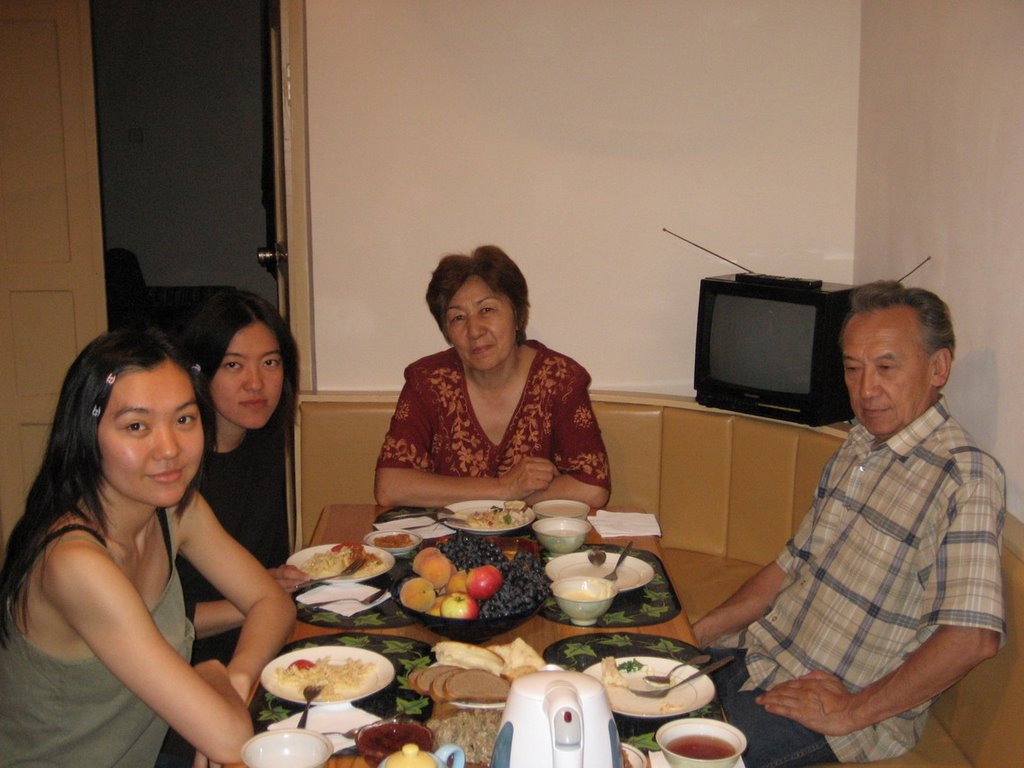
I have been emailing back and forth with a tourism agent who connects tourists with homestays. I want to spend my first month in a homestay. This is much longer than normal. On relatively short notice the agent was struggling to place me with a family as the families normally like to have guests just for a day for a two and work off of a set price list for meals and what not. So she asked her mother. The mother agreed. So I will be staying with the tourist agent's mother. The daughters now live on their own.
It begins.
Illicit... Bulgaria.... Scotsman... Language and Other Otherwise Unrelated Thoughts
October 16th - Sofia, Bulgaria
Illicit Political Economy in
Brendan Former Afghanistan Expat Goody-do-right Scott, Anja German Student of Bulgarian Social-Realist Literature and I Babbling Idiot went out Friday night. We searched
“
Back in the center it was decided that the last viable option would be
Human Trafficking
Perhaps by coincindence an American woman of 25 years arrived to the hostel the next day. She has lived in various parts of
Good looking Eastern European girls (of which there are many, a typical Eastern European build resembles the ideals of beauty in the West and thus the world) are approached by a friend, relative, or a “business recruitment” agency. The ladies come from places where there is little hope for the lifestyle promoted by magazine, song, and film should they stay at home. Promised high wages and the dream of a good life in a Western country, they are duped into leaving everything behind and to trust the guidance of an agency. The places they are promised work often do actually exist or at least have web-pages. Those that exist outside of virtual reality rarely are aware of their Moldovan recruitment efforts.
Once displaced their lives or the lives of their families are threatened and the girls are put to work, most often as prostitutes. A cost of $2,000 for documents and transportation becomes an exorbinant debt of tens of thousands of dollars that must be “paid back.” Large destinations for Eastern European women include
Several organizations work to repatriate the girls. This typically costs about US$ 10,000. An ounce of prevention often is worth more than a pound of damage control. The American woman hoped to resolve the sources of the problem, namely the inability of the girls to assess the claims of recruiters and the complete lack of alternative economic opportunities. A few distinct ideas seemed to appear over the course of our conversation:
- Microfinance for girls to have opportunities other than taking a chance.
- An informal network of people to check into the proclaimed destination of a recruiter
- A certification organization to look into the claims of actual talent recruitment business.
- Traveling education lectures to visit the most likely victims (this approach is currently supposedly undertaken by some huge NGOs whose names I forget).
Ideas about education are a simple start but the level of desperation that compels someone to leave home all on their own despite the apparent obvious risks makes a DARE-style lecture seem to me unlikely to have lasting effects (of course if you sway 1 or 2% on the fence not to do it, that is significant).
The technique used to rope girls into this blatantly evil practice strike me as unusually devious and malicious. People need hope. Coming from a bleak past and with vision only of a bleak future, the need to hope compels an individual to take an ill-advised chance… perhaps even if they know it is ill-advised. The endemic nature of corruption in many source and destination countries makes working through governments towards enforcement little more than wishful thinking.
I hope that people like the American woman find ways to start initiatives like those listed above. If anyone who reads this wants to know more, email me and I get you in contact with the under-experienced 25 year-old
Talking and thinking about this made me look back on the run in with the “not-professional” prostitute in Ohrid with renewed nausea. My intuition tells me that her situation is much different from those trafficked but prostitution still sucks.
Brendan’s Plan to Save the World or Get Rich Trying
I spent the majority of the last week bumming around with Brendan, a 26 year-old Scotts-man with a flair for quoting literature and poetry, a zestfully bleak attitude to veil his deeper optimism and a height of 6 feet 5 inches. Brendan is intelligent and hardworking, characteristics that led him to the highest academic heights of British and American law programs. Working single-mindedly with every waking minute to achieve academically burned the man out eventually. To be first in your class offers a path so well worn for such a golden child of
Brendan and I conversed epically to a fault. Even attempts to talk about women in the most superficial of ways turned into dialogues exploring what shaped our opinions. Eventually resigned to our fate, we drank begrudgingly to endlessly good conversation. Brendan, upon returning to
I learned a great deal from Brendan. His presence in
Random thoughts on Language and Culture (cont’d from last entry?)
Brendan traveled through
Learning languages is like seeing new colors. These colors may only be concepts of the mind but nevertheless the richness of perception of the world increases exponentially.
October 19, 2006 –
I have abandoned all hope of seeing my precious visa credit card ever again. After departing
I did the bus dance for two days. I was very sick for the first day, which worked out well. I was stuck on a bus where I could expect only to be cramped and sweaty and where I could hope only for sleep. Stiff and sweaty from fever, sleeping was all I wanted to do. After a brief layover in
Sometimes the fulfillment of a stereotype can be a beautiful thing.
Wednesday, October 18, 2006
update's a-comin!
I have a lengthy post on my computer that i have been unable to post.
here is what's on tap:
Sofia is a land of gurus.
My Long-Held Suspicions that New Jersey Is the Black Hole that Sucks the Life Out of All Things Pure and Good Have Been Confirmed.
My fever broke on hour 20 of the Sofia-Prague express.
The Koran is not a "page-turner."
here is what's on tap:
Sofia is a land of gurus.
My Long-Held Suspicions that New Jersey Is the Black Hole that Sucks the Life Out of All Things Pure and Good Have Been Confirmed.
My fever broke on hour 20 of the Sofia-Prague express.
The Koran is not a "page-turner."
Friday, October 13, 2006
October 12 – Sofia, Bulgaria.
October 12 –
Social customs remind me a bit of
“No.”
“Why not? She is not pretty? You don’t like Albanian women?”
Another day off the map. We parted ways as I boarded the bus bound for Sofia and they for
I met interesting people on the bus. A young couple of about 30 kept an eye out for my well being and informed me of when I was being corrected by the driver (the lack of eye contact killed any comprehension meager Russian might afford). An Albanian student in
Upon hearing me speak English the doctor was keen to practice his. After a few early stumbles within 20 minutes he was unstoppable. What started as a mundane conversation about family became a discussion of borders, identity and race. This progression is quite natural when people ask about my name, where my family is from or about how they have family living in
I mostly listened, putting in a word or two here and there about staying in SA several months “liking Mexican” but the hints of difference or opinion were brushed aside with a “well, yes perhaps I agree, BUT…” onward and downward. He regretted the privatization of
There was a time not long ago when I would have responded with a “yes, perhaps I agree, BUT…” all my own. I tend to find myself defending open markets, but then I know of nothing else in practice, having grown up in the states. For him the socialist security of the past meant low wages, cheap goods and a good life on the whole. It sounds like endemic stifling of potential to me.
Now while I maintain personal preferences of comfort on issues like race, socialism and dinner tonight, I no longer see any system of belief, governance or living as inherently better or worse. Perhaps such distinctions can be made on a case by case basis but not upon ideas as a whole. When I lived with my Stalinist host family in
These sorts of experiences draw me way from a clear picture of truth and toward an evaluation of relevance. This equivocates any lesson to be gleaned from an experience while recognizing the subtlety of variation. The weakness of this perspective is its strength. I live for seeing (or perhaps imagining) beautiful paradoxes like that. To me, they are moments of epiphany.
Learning languages well also holds lessons that I value very deeply about the subjectivity of cultural perception. This is most clear in the translation of closely related concepts. “Sorry” in English is translated (or poorly transliterated, as the case may be) as “iz-ven-eet-tia” in Russian. Sorry suggests compassion, and shared sorrow for another’s suffering, though we use it so often that it has lost this gravity. It is the speaker who is active in English by expressing her reaction of regret. In Russian, the phrase is a verb conjugated in the second person formal and means something more like forgive me. It is similarly used only slightly less frivolously than its English counterpart. Russians are far less inclined to establish themselves as the principle actors in their sentences. English is full of possession and personal initiative. The differences are trivial translations at first glance, but taken as a whole they add up to a significantly distinct world outlook. English speakers see themselves as able to affect change boldly in the world. Russians see themselves as the recipients of others’ or God’s actions.
To stretch the applicability of the idea perhaps beyond capacity, I would utilize the framework for justifying Russian as well as American expansionary and interventionist policy. Russians perceive rivalry and subversion along their borders (others negatively causing injury to
From my limited familiarity with the period of
A writer/editor for
People almost always tend to pursue their interests to the nth degree. Climbers want to climb the hardest route, swimmers to swim the fastest and runners to run the farthest. Travelers to travel further and homemakers to perfect the abode. Linguists search for odd, dying languages and anthropologists for unique cultures. Each person is both admirably determined to get the most out of their experience and trapped into alleys of narrow definition by this process. In considering motivations from this perspective, I wondered what compels me to go to
It is another tally mark on the vain score-card of the odd and remarkable places briefly where I have briefly lived. It is the chance to broaden and deepen my youth-guide identity. It is to solidify my Russian and grow another tongue in a futile effort to understand everyone. I have a specific curiosity now after reading part of the Koran. The Koran is more prescriptive in its approach to handling everyday affairs than I would have guessed. I want to know how it is that Kyrgyz people reconcile their identity as a secular Islamic society. According to my reading of the Koran so far this is akin to proclaiming oneself to be a married bachelor.
I suspect that perhaps the effort to establish order through rigidity may be self-defeating. In Islam’s case, so much is at stake that competing claims for the all-or-nothing legitimacy resulted in decentralized religious authority and dissent though the holy book clearly declaims this outcome.
Subscribe to:
Posts (Atom)

